Live XR Neuroanatomy Teaching — Cumbria & Imperial
VR / AR · Education Technology
Live XR Neuroanatomy Teaching — Cumbria & Imperial
Wednesday 11th March 2026 · Pears Cumbria School of Medicine
Overview
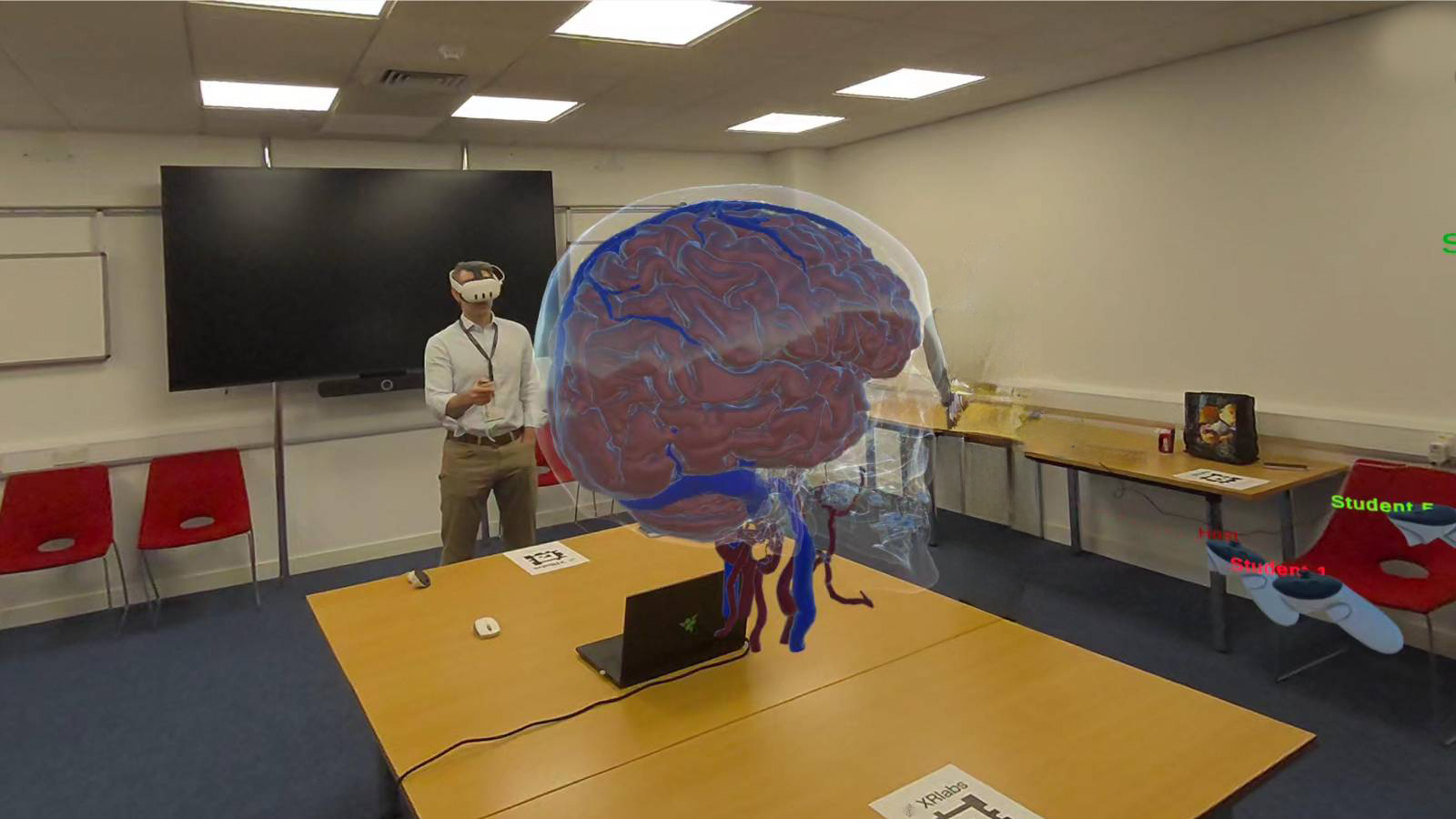
In March 2026, we delivered a landmark live XR neuroanatomy teaching session at the Pears Cumbria School of Medicine campus — connecting Imperial London’s Faculty of Medicine with students at the University of Cumbria. Using Meta Quest headsets loaded with the XRLabs immersive neuroanatomy application, medical students were able to explore and interact with a detailed 3D model of the human brain and cranial anatomy in real time.
The session formed part of the ICSM/PCSM (Imperial School of Medicine / Pears Cumbria School of Medicine) collaborative curriculum, and represented a significant step forward in delivering immersive, technology-enhanced anatomy education to students based outside London.
Session at a Glance
| Date | Wednesday 11th March 2026 |
| Location | Pears Cumbria School of Medicine, Carlisle |
| Students | ~15 PCSM medical students (delivered as 3 sessions of 5) |
| Technology | Meta Quest headsets & XRLabs neuroanatomy application |
| Subject | Neuroanatomy (brain & cranial structures) |
| Outcome | Successfully delivered — highly praised by senior leadership |
Technology & Approach
The XRLabs application was remotely deployed to a fleet of Meta Quest headsets via MDM (Mobile Device Management), removing the need for the technology team to be physically present at the Cumbria campus. Students were able to put on the headsets and immediately explore high-fidelity 3D anatomical models, guided by the session facilitator.
Groups of five students rotated through the XR experience, each having hands-on time with the headsets. The session was designed to complement existing anatomy teaching and provide students with a spatial, immersive understanding of complex neuroanatomical structures that are difficult to appreciate through traditional 2D resources.
“Really heart-warming! Very many thanks to all of you for making this work!”
— Professor Amir H. Sam, Head of Imperial School of Medicine & Consultant Physician, Imperial Healthcare NHS Trust
Partners & Collaborators
This project was a truly collaborative effort, bringing together teams across institutions:
- Imperial London, Faculty of Medicine — Dr Olivia Parish (Clinical Education Fellow), Adrian Cowell (Innovation Lead)
- Pears Cumbria School of Medicine — Philip Moses-Allison (academic lead), Charlotte Young (photography & support)
- XRLabs — Ali Haddad, Marcel Fojk, Titas Takrim (XR app development & deployment)
- Imperial Healthcare NHS Trust — Mr Arthur Dalton (Consultant Neurosurgeon), Mr Puneet Sharma
Impact & Next Steps
The session was received extremely positively by students, staff, and senior academic leadership. It demonstrated the viability of delivering high-quality immersive anatomy education remotely — without specialist in-person technical support — opening up the possibility of scaling XR teaching to regional campuses across the UK.
The success of this pilot will inform future collaborative sessions between Imperial and Cumbria, and supports the broader case for embedding XR technology into undergraduate medical education curricula.